Pages

Friday, August 1, 2014

Goddess of Laws, Justitia

Welcome back, everyone. This is Ascriptmaster here back with another Cardfight!! Vanguard deck profile. This deck is focused on a Genesis promo card from the Lock Break Campaign, Goddess of Laws, Justitia. This card uses a Soul Saver Dragon style Limit Break to power up its allies for powerful attacks.
[ACT](VC) Limit Break 4 (This ability is active if you have four or more damage):[Soul Blast (6)] Choose up to three of your «Genesis» rear-guards, and those units get [Power]+5000 until end of turn. This ability cannot be used for the rest of that turn.

[ACT](VC):[Counter Blast (1)] Choose one of your locked cards, and unlock it.

[CONT](VC/RC): Lord (If you have a unit without a same clan as this unit, this unit cannot attack)

If you have unshakable faith, you would not succumb.

Grade 0

Battle Maiden, Amenohoakari
4 Battle Maiden, Kukurihime
2 Lemon Witch, Limonccino
3 Spark Cockerel
3 Patrol Guardian
4 Witch of Big Pots, Laurier

Grade 1

4 Goddess of Self-sacrifice, Kushinada
4 Orange Witch, Valencia
3 Existence Angel
3 Witch of Frogs, Melissa

Grade 2

3 Battle Maiden, Sahohime
3 Broom Witch, Callaway
3 Witch of Owls, Paprika
3 Witch of Ravens, Chamomile

Grade 3

4 Goddess of Laws, Justitia
4 Oracle Queen, Himiko
With Justitia's Limit Break powering up 3 rearguards at the same time, it was only natural that stand triggers be included into the trigger lineup. Stand triggers allow your already-strengthened rearguards to attack more times within the turn, forcing more guard from the opponent. Oracle Queen, Himiko also aids in this by giving the units even more power the turn you Break Ride, making a stand trigger potentially devastating when the opponent faces an additional rearguard attack at +15,000 Power, thanks to the combined effects of the trigger, Justitia, and Himiko.

Like many Genesis ace units, Justitia highly values quick Soulcharge opportunities that let it use its skills. Existence Angels and Battle Maiden Amenohoakari aid in its venture, boosting units and giving quick Soul. The deck also uses the traditional Soul-based units that gain effects when sent to the Drop Zone, such as Valencia, Melissa, and Chamomile. More Valencias have been included instead of Melissas because the additional Soulcharge is appreciated as it sets Justitia up to Limit Break the turn after as well. However, her Grade 2 cousin Grappa was removed in favor of pressure units like Callaway, and high-power units like Paprika, who take advantage of stand triggers nicely, the former for its pressure and on-hit draw, and the latter for its higher power to more easily hit the Vanguard.

Friday, July 25, 2014

Seekers

Hello everyone Natsu here back for another Vanguard deck profile article and this week we're going to be taking a look at Seekers, the new Royal Paladin archetype used by Kai in the beginning of the Legion Mate arc and how I decided to build the deck.

Grade 0

Advance Party Seeker File
Certain Kill Seeker, Modron x4
Seeker, Harold Breath Dragon x4
Seeker, Loving Healer x4
Margal x4

So for our triggers I went with the standard build and File as the starter in order to get a starter that can place himself back into my soul for a mid game retire and to help pay for Sing Saver's hefty soul blast cost (or at least hefty for this clan).  Like most other Seeker builds Margal is used as the draw trigger for a quick +3k to a unit for magic numbers and a +1 to soul while losing only 5k shield in the process.

Grade 1

Glynngal Seeker x4
Good Faith Seeker, Cynric x4
Guardian Law Seeker, Shiron x4
Seeker, Rune Eagle x3

My grade 1 lineup is also pretty standard for the most part with Glynngal who when boosting a Blaster Blade Seeker attack that hits lets you unflip and cycle through your cards.  Due to legion rulings if he boosts a Sing Saver in legion his skill will go off so it can add pressure to your Vanguard attacks since sometimes you can eat up counterblast in this deck quickly.  Next is Cynric who is our standard 10k grade 1 attacker to help push your opponent to high damage early on, and Shiron is our standard perfect guard.  I opted to not play Quintent Wall in this build because I feel that I already use up enough counterblast with my other cards and usually can just guard the 4 cards to my damage zone if I need to.  Lastly Rune Eagle is a 10k booster when you're in Legion so that you can hit 32k with your Sing Saver Dragon.

Grade 2

Blaster Blade Seeker x3
Romance Seeker, Cerdric x3
Crossbow Seeker, Gildas x2
Total Force Seeker, Locrinus x2

For our grade 2s due to my choice of back up Legion vanguard the variety is bigger than my normal grade 2 line ups.  First we run 3 Blaster Blade Seeker who is Sing Saver's Legion Mate and who by counterblasting 1 when he's called can retire a grade 2 or higher rear guard so long as your Vanguard is a Seeker.  Then I run Cerdric who is the 12k attacker for the Seeker archetype, for standard number pressure.  Next is Gildas who when you legion can counterblast 1 and get you ANY Seeker from your deck, which can help you gain more field presence and help push for game.  Then lastly I run 2 Locrinus who is the legion mate for Brutus (who I'll talk about later) and has a skill of being a 13k attacker during the turn you legion.

Grade 3

Seeker, Sing Saver Dragon x4
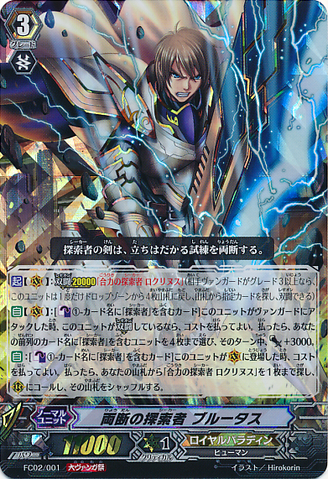
Bifurication Seeker, Brutus x4


First is Sing Saver Dragon who when in Legion can counterblast 2, soulblast 3 and discard to in order to ride another copy from
your deck at stand AND perform legion with a Blaster Blade Seeker from your soul.  The soul blast cost makes the skill a usually once per game skill, but the key with this deck is knowing when to use the skill due to royal paladin not having an efficient way to build up soul to have the skill go off more than once a game (although possible if you have the Margals for it).  Generally you'll want to use this skill in a push for game so that you can finish off your opponent.  The other grade 3 I chose to run was Brutus, his legion mate is Locrinus and his skill is by especial counterblasting 1 you can give your whole front row (the legion mate included) 3000 power.  So he alone will swing for 26k every turn unboosted which hits magic numbers against a lot of decks and since most clans will now have a legion and we're moving towards a legion meta, this only makes him an even better unit.  He can help add more pressure then Sing Saver and then you can ride Sing Saver over him to make a final push for game.

Overall this deck is a very good deck and it's very clear why it's been dominating most of Japan.  The deck has the ability of Raging Form Dragon where it holds 2 Vanguard attacks over its opponents while also at the same time is like Zerachiel where it can power up all of it's rows for high numbers to quickly drain and opponent's hand.  The only issue that this deck can have is sometimes running out of counterblast and in the hands of less experienced players not knowing the proper time to use Sing Saver's skill.

Friday, July 18, 2014

Ancient Dragon, Volcatops

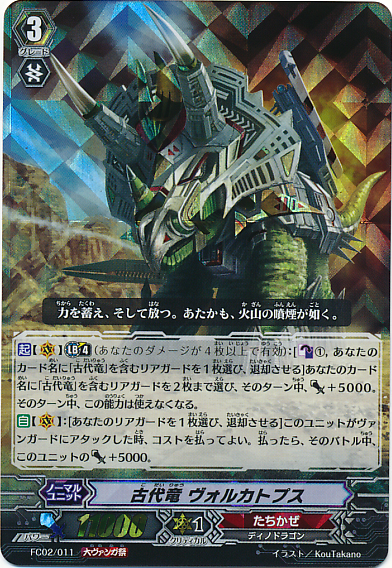
Hello everyone, this is Ascriptmaster here, back with another Cardfight!! Vanguard deck profile. Today we will be focusing on a new card from Fighters' Collection 2014, Ancient Dragon, Volcatops. Volcatops diverges from most other Tachikaze aces by using its skill to give rearguards power, while other aces primarily focus on giving power to themselves. Here is a video of the deck in action.
[ACT](VC) Limit Break 4 (This ability is active if you have four or more damage):[Counter Blast (1) & Choose one of your rear-guards with "Ancient Dragon" in its card name, and retire it] Choose up to two of your rear-guards with "Ancient Dragon" in its card name, and those units get [Power]+5000 until end of turn. This ability cannot be used for the rest of that turn.

[AUTO](VC):[Choose one of your rear-guards, and retire it] When this unit attacks a vanguard, you may pay the cost. If you do, this unit gets [Power]+5000 until end of that battle.
To store up energy, and then release it. It is like how a volcano erupts.

Grade 0

Ancient Dragon, Baby Rex
4 Ancient Dragon, Ornithhealer
4 Ancient Dragon, Caudinoise
4 Ancient Dragon, Dinodile
4 Black Cannon Tiger

Grade 1

4 Ancient Dragon, Iguanogorg
4 Ancient Dragon, Paraswall
3 Sonic Noa
2 Ancient Dragon, Gattlingaro

Grade 2

4 Ancient Dragon, Beamankylo
4 Ancient Dragon, Dinocrowd
3 Ancient Dragon, Criollofall

Grade 3

4 Ancient Dragon, Volcatops
3 Ancient Dragon, Spinodriver
2 Ancient Dragon, Tyrannolegend
To start, the deck runs a full lineup of Iguanogorg and leads with Baby Rex. Both of these units are very useful because their abilities allow them to replace themselves when they are retired. Baby Rex is particularly nice because I can use Volcatops' second skill or one of my Dinocrowd to retire it and search out a Tyrannolegend, giving me an extra attack. Iguanogorg is also useful in this regard as its revival ability allows it to fulfill a role as booster for both rear-guard columns, by attacking with one column first, then attacking with Volcatops and retiring Iganogorg for its second skill.

Since Volcatops boosts rearguards instead of itself with its Limit Break, it benefits from stand triggers just as much as it does from critical triggers, as the rearguards will stand with increased power to force additional guard. I personally chose to only use 4 stands in my deck, but I recommend that you try out whatever combination of triggers that works for you.

My Grade 3 lineup focuses on Volcatops and Spinodriver as the main units to have as the Vanguard, Spinodriver being extremely useful as a Break Ride that gives criticals and draw power. The two Tyrannolegend act mainly as targets for Baby Rex, but if push comes to shove and I need to ride it, it serves decently as a Vanguard, albeit one that struggles to synergize with Stand Triggers because of its demanding Limit Break retiring 3 units.

Friday, July 4, 2014

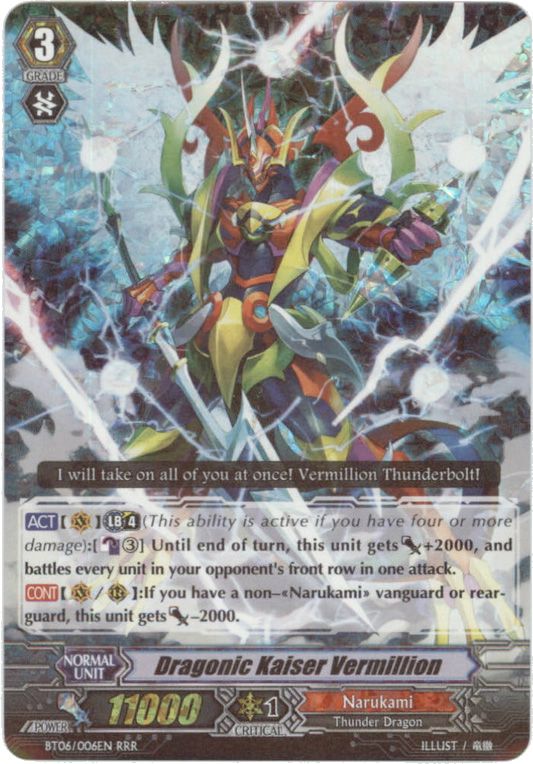
Dragonic Kaiser Vermillion

Hello everyone, this is Ascriptmaster with another Cardfight!! Vanguard deck profile. This week focuses on Dragonic Kaiser Vermillion and its Crossride, and their abilities to quickly wipe the opposing front row as well as maintaining a crossride defense.

Grade 0

Lizard Soldier, Saishin
4 Brawler, Green Gem Carbuncle
4 Brawler, Plasma Kick Dragon
4 Malevolent Djinn
4 Spark Edge Dracokid

Grade 1

4 Eradicator Wyvern Guard, Guld
4 Certain Kill Eradicator, Ouei
4 Red River Dragoon
2 Eradicator of Fire, Kohkaiji

Grade 2

4 Demonic Dragon Berserker, Garuda
4 Dragonic Deathscythe
3 Dusty Plasma Dragon

Grade 3

4 Dragonic Kaiser Vermillion
4 Dragonic Kaiser Vermillion "THE BLOOD"
I will take on all of you at once! Vermillion Thunderbolt!
This is the final thunder.
Let’s go, Vermillion Catastrophe!
The general strategy of Dragonic Kaiser Vermillion is to forgo the Ultimate Break of the Crossride due to its restriction to 5 damage, and instead use it solely for its crossride defenses after the original's Limit Break has been used. Their aggressive style is complemented by a 12-crit lineup that uses the criticals to push the opponent into a corner. Saishin was chosen over Spark Kid Dragoon's ability to look for Grade 3 units and Djinn of Wishing Thunder's draw power because of his ability to boost for 5,000 and the potential pressure against decks whose First Vanguard remains on the field or otherwise rely on a Grade 0 for their abilities (like Cat Butler). While Brawler of Battles, Haoka's skill would allow me to retire a backrow unit alongside a frontrow unit that Vermillion retires, its nature as a Stand Trigger conflicts with Vermillion's Limit Break, which all but requires it to attack first.

For Grade 1 units I chose to opt out of using Rising Phoenix for draw power, due to Vermillion's lack of a consistent Soul engine, unlike Eradicators, and went for a fully offensive booster lineup. Red River Dragoon is a standard vanilla booster, and Kohkaiji boosts the Vanguard for 10,000. Certain Kill Eradicator, Ouei is also a nice booster whose skill is an added bonus to remove more units from the opponent's field and force them to spend resources to bring them back. While one could argue that Ouei provides a small Soul engine for Rising Phoenix, I felt that powerful boosters were more important for this particular playstyle and if Red River Dragoon were to be replaced, it would be for another booster with a good ability instead.

The remainder of the deck focuses on beatdown as well. Garuda's ability to flip damage face-up puts pressure on the opponent because of the threat of another Vermillion attack. Dragonic Deathscythe adds one more retiring option to the deck, using the last 2 Counterblast left by Vermillion to retire one last unit; while it appears counter-intuitive to include 4 copies when only one will likely be used, the increased likelihood of drawing it and the fact that it still serves as a good attacker mitigate that.

Friday, June 27, 2014

Jewel Knights

Hello everyone Natsu back with a look into Jewel Knights.  Jewel Knights were the 2nd archetype introduced into Royal Paladin back in set 10.

Grade 0

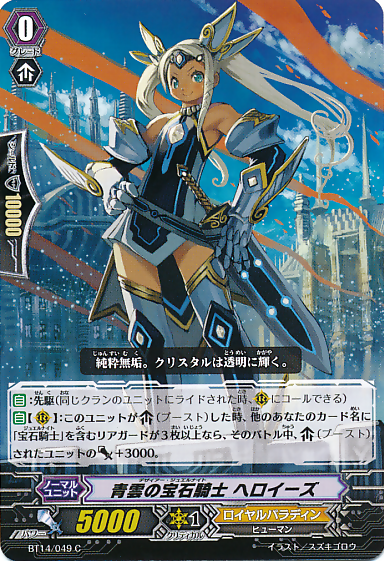
Desire Jewel Knight, Heloise
Blazing Jewel Knight, Rachelle x4
Jewel Knight, Noble Stinger x4
Enthusiastic Jewel Knight, Polly x4
Jewel Knight, Sacred Unicorn x4

So for our starter we run Heloise who if you have 4 other Jewel Knights becomes an 8k booster which is definitely very nice because if she's boosting a successfully cross-ridden Ashley you'll have a 21k vanguard column which just hits magic numbers for many decks.  Then as we run no on hit units for the deck I use the standard 8 critical and 4 draw trigger line up since there are no on hit units in the deck stands aren't all that great for this build.

Grade 1

Flashing Jewel Knight, Iseult x4
Security Jewel Knight, Arwen x4
Stinging Jewel Knight, Sherrie x4
Jewel Knight, Prizme x3


For our grade 1s we run 4 Iseult who is our perfect guard, although Jewel Knights did introduce the Quintet Wall to the game, it's not too great for this build of Royal Paladin.  Next up is Security Jewel Knight, Arwen who can put an Ashley unit (basically any grade 3) from your drop zone and put it on the bottom of your deck to give another Ashely unit 5000 power.  This is good for adding extra power to your late game pushes and makes up for the loss of power from locking a unit from Ahsley Яeverse's skill.  Lastly there's Sherrie who is a 10k attacker so long as you have 3 other Jewel Knights out on the field and Prizme who with the same condition is an on call drop and draw which can help add food for Arwen and also help you have Ahsley Яeverse at 13k.


Grade 2

Banding Jewel Knight, Miranda x4
Dogmatize Jewel Knight, Sybill x3
Linking Jewel Knight, Tilda x3

For our grade 2s we run 4 Miranda who's an 11k attacker for the Ashley archetype archetype, and if she hits give another Royal Paladin 3k power for the turn which can sometimes help pressure for numbers if you have your columns set up right.  Then there's Sybill who on call can Counterblast 2 to get any grade 1 or lower Jewel Knight to your field from your deck.  This combos really well with  Ahsley Яeverse because it turns your +2 into a +3, although the cost can add up and be hefty it can also be very helpful too.  Lastly we run 3 Tilda, who when a grade 3 is ridden can counterblast 1 to get any grade 1 or less Royal Paladin from your deck and call it.  This can further add to the pluses that the deck allows you to get with a cheaper counterblast cost than Sybill although more situational.

Grade 3

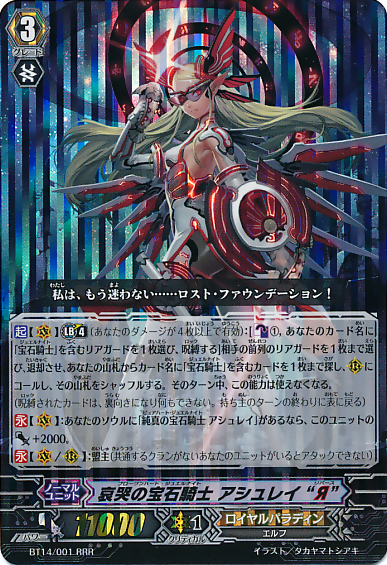
Pure Heart Jewel Knight, Ashley x4
Broken Heart Jewel Knight, Ahsley Яeverse x4

Lastly for grade 3s we run 4 Ashley and 4  Ahsley Яeverse.  Ashley's breakride skill is to give an extra critical as well as 10k power which isn't too great when compared to other breakrides out there, however Ahsley Яeverse is a whole other story.  It's a crossride so it has a 13k base, and it's main skill is to lock 1 unit and counterblast 1 so you can retire an opponent's front row unit AND get ANY Jewel Knight from your deck.  It's a once per turn ability, but even then it's still really good since it allows you to go +2 every turn, not only that but it combos really well with a lot of other units in the deck and makes a gap of 10k shield ideally with your opponent every turn.

Overall the new Jewel Knight support from set 14 was DESPERATELY needed by this archetype and allows the deck to take on a strategy where you basically out plus your opponent so hard that you can overwhelm them and win.

Friday, June 20, 2014

Locking For Days: Star-Vader Dark Band Dragon

Hello Everyone, I’m ddr101 aka ThatAsianGuy and I’m going to talk about an interesting build for Link Joker. Everyone knows the cookie cutter decks for Link Joker are Glendios, Chaos Breaker Dragon, and Nebula Lord.  However, each of these cards has a niche way of using the lock mechanic for a different means: Nebula uses it to power up the front row from its Limit break, Chaos Breaker Dragon to increase hand advantage, and Glendios going for the eternal lockdown and a win condition.  However, each of these cards’ lock feature usually have a hefty cost of CB or a limitation of uses per turn, which really made me irritated because I felt that Link Joker’s main intention was to lock as often as possible.

So looking into the other Link Joker cards in the English Format, I found a card that allowed me to lock multiple times a turn at a cheap cost: Star-Vader, Dark Band Dragon. Before people start discrediting me for choosing this card, I want to tell you this, this card may seem weak to you at first, but when the deck is built correctly and played out well, you can see this card can be as troublesome as its more expensive bigger brothers.

Grade 0:
1x Dust Tail Unicorn (Starter)
4x Star-Vader, Meteor Liger  (Critical)      
4x Star-Vader, Weiss Soldat (Critical)
4x Star-Vader, Nebula Captor (Draw)    
4x Star-Vader, Stellar Garage (Heal)

This is pretty standard for most Link Joker decks, excluding the Standing Nebula Beat-down play style, I prefer to use this trigger line-up on this deck because of the flexibility with the other units of the deck to hit the magic number of your opponent’s vanguard or rearguard units.  This way, the flexibility allows you to choose your targets carefully while continually applying lots of pressure from the critical triggers. The draws are mainly used as your technical draw engine; since there isn’t any other way to get units added to your hand in this deck, the draws play a major role in the deck to set up you optimal field against your opponent.


Grade 1:
2x Star-Vader, Aurora Eagle (10k Vanguard Booster)
4x Demon Claw Star-Vader, Lanthanum
4x Prison Gate Star-Vader, Palladium
4x Barrier Star-Vader, Promethium (Perfect Guard)

This line-up of grade one units really are the core of field presence in the deck as the Aurora Eagle and the Demon Claw Star-Vader, Lanthanum play a key part in keeping your continuous field pressure there.  Aurora Eagle and Demon Claw Star-Vader, Lanthanum does this in conjunction to Star-Vader, Dark Band Dragon’s Limit Break skill.  Dark Band Dragon’s Limit Break is that you counterblast one card in your damage zone with Star-Vader in its name and you lock a back row unit.  Aurora Eagle requires you to have more rearguards than your opponent to give your Vanguard a 10k boost, which can be easily done since Dark Band Dragon’s skill has no limitation on how many times a turn it can be used.  

However, when I use Dark Band Dragon’s skill, I use it usually when I and my opponent are at full field or when I have a pesky booster I have to deal with.  Even when we both are at a full field, only using Dark Band Dragon’s skill once will activate Aurora Eagle’s skill. The same goes for Demon Claw Star-Vader, Lanthanum as its skill allows it to gain 2k when a unit is locked by one of your card effects, with Dark Band’s skill, you can easily set up your field to hit the magic numbers you need against your opponent’s vanguard or rearguard units.


Palladium has great synergy with every Link Joker deck, but even more so in this deck.  From Infinite Zero's Break Ride effect or Dust Tail Unicorn's skill, you can easily lock the front row and keep it locked with Palladium. This help with lowering the amount of attacks coming your way, if you are behind in cards in hand.


Grade 2 :

4x Unrivaled Star-Vader, Radon(12k attacker)
4x Furious Claw Star-Vader, Niobium
3x Star-Vader, Colony Maker

This grade two line-up will be your main front row rearguards that you will have in most of your cardfights, because when combined with the grade ones and Dark Band Dragon’s skill, everything comes together. The Radon combined with our Demon Claw Star-Vader Lanthanum is a good unit combination normally as the attack total would usually be around 19k or 24k with one trigger placed on it, but in conjunction with 1 use of Dark Band Dragon’s skill, Lanthanum will gain 2k on the boost which allows that column to push for 21k or 26k with one trigger. This column will be able to hit most vanguards in the current English meta, excluding Cross-ride units like Lequier Reverse, Vowing Saber Reverse, etc.  However, with our other unit Niobium with a Palladium or a Lanthanum, the column can hit 18k with a Palladium or it can hit 20k when paired with a Lanthanum and Dark Band Dragon’s skill once.   


Our last grade 2, Colony Maker, allows us to set up the field in whatever way we need it as the skill for Colony Maker calls out a Star-Vader card from the deck, but it doesn’t have to be in the same column, which allows you to search for an Aurora Eagle for the vanguard or a Lanthanum for the other rearguard; however, the only drawback to Colony Maker is that it requires a locked unit before its effect can activate.  This problem is easily solved when you look at our grade three line-up as locking a unit will either be upon break ride or for the measly cost of one counterblast.


Grade 3:
4x Star-Vader, Infinite Zero Dragon (Break Ride)
4x Star-Vader, Dark Band Dragon (Main Unit)

This line-up allows you to lock your opponent often and make the most of it with your units.  Infinite Zero’s skill is pretty self-explanatory as it allows you to lock one unit in the front row and back row once a unit rides over it.  This in combination with Colony Maker can help you set up you ideal field even before you ride the Dark Band Dragon.  The main unit for this deck Dark Band Dragon really pulls all of the cards together as you can control the number of all of your units to hit the best possible magic number against your opponent.  Dark Band Dragon itself is a 10k base vanguard, but don’t let that fool you. 

The second ability of Dark Band Dragon is that it gains 3k if you have more rearguards than your opponent when you are attacking.  This effect works for any attack target too, whether it is vanguard or rearguard.  Depending on the unit behind Dark Band Dragon, Dark Band Dragon can hit 13k by itself, 18k with Dust Tail Unicorn, 20k with Lanthanum or Palladium, 22k with Lanthanum with Dark Band locking one unit, or 23k with Aurora Eagle with Dark Band locking at least one unit.  Dark Band Dragon allows great versatility with its locking skill and its power gaining effect, which in conjunction with units like Colony Maker or Lanthanum can cause a lot of chaos for your opponent. Even with a 10k base making it harder to guard, Dark Band Dragon is still a fun card to use as your opponent scrambles to find cards to guard with as you are hitting their units’ magic number every turn.  

    This deck really shows that with the right amount of experience and deck building, you can make versatile decks with cards that people rarely give the chance to playtest.  If you want more from ThatAsianGuy, please comment down below about your impressions about the deck. You can also put down other clans that you want to see decklists for. ThatAsianGuy, Over and Out.

Friday, June 13, 2014

Star-vader, Freeze Ray Dragon

Hello everyone, this is Ascriptmaster here, b̷̧a̡c̨͟͏̴̢k̸̀͞ ̵̶̵͘̕w̶̶̧̨i̡t̀͘̕͞ḩ̛̕ ̵̶͡ą́͜n̵̢͡ơ̡̡̕͘t̡͏h̸̛͞e̡̡͜͠͝r̸͞ ̶̡͞Ç̶a̕͜͠r̶̶̸̨͢d̵̢̛̕͠s͞҉̶̵͜à̶̵̡͠f̵̨͟͡#̨̨̀͠͡5̶̨͘̕͟7̨̨̧́͡X̧̨̛̕8̸̸̧9̡͢͞͞͝0̵̷̧̕͘-̶͢͟͜͝-́͘͏͢-̵̢̡
INJECTING LINKJOKER\STARVADER.BAT
DECODING: 33124d36d39ae7c013e95c54d698807e
------- VOID PROGRAM INITIATED -------
> SELECT * FROM FREEZERAY.DEK
... ORDER BY GRADE, AMT, NAME;

-----ACCESS GRADE [0]-----

> EARNEST STAR-VADER, SELENIUM
> [4] STAR-VADER, METEOR LIGER
> [4] STAR-VADER, SCOUTING FERRIS
> [4] STAR-VADER, STELLAR GARAGE
> [4] STAR-VADER, WEISS SOLDAT

-----ACCESS GRADE [1]-----

> [4] BARRIER STAR-VADER, PROMETHEUM
> [4] PRISON STAR-VADER, PALLADIUM
> [3] TWIN BLADE HOLLOW, BINARY STAR
> [2] IMAGINARY OTHROS
> [2] STAR-VADER, AURORA EAGLE

-----ACCESS GRADE [2]-----

> [3] NEGLIGIBLE HYDRA
> [3] STAR-VADER, COLONY MAKER
> [3] UNRIVALED STAR-VADER, RADON
> [2] STAR-VADER, MOEBIUS BREATH DRAGON

-----ACCESS GRADE [3]-----

> [4] STAR-VADER, FREEZE RAY DRAGON
> [3] STAR-VADER, NEBULA LORD DRAGON
> DECKSTRAT FREEZERAY.DEK
DECKSTRATEGY FOR FREEZE RAY DRAGON:
- LOCK OPPOSING REARGUARDS IN THE MIDDLE OF THEIR TURN
- USE PRISON STAR-VADER, PALLADIUM TO MAINTAIN THE LOCK
- USE SELF-DAMAGING UNITS TO LOCK MORE UNITS DURING YOUR TURN
- DOES NOT REQUIRE LIMIT BREAK OR COST FOR LOCKING PROTOCOL
- NEBULA LORD DRAGON AS BACKUP VANGUARD W/O SUBCLAN RESTRICTION
> LOGOUT
------- CONNECTION TERMINATED -------